
BREED HISTORY
From a working dog of Portuguese fishermen to today’s family companion – the history of the Portuguese Water Dog has been inseparably linked to the sea for centuries.
THE PORTUGUESE FISHERMEN’S DOG
The Portuguese Water Dog is a native Portuguese breed that was closely connected with the lives of fishermen along the Portuguese coast for centuries, particularly in the Algarve region.
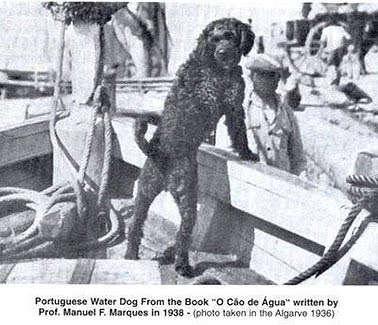
Portuguese Water Dogs have a water-resistant coat and pronounced webbing between their toes, which helps them swim and dive. Thanks to their excellent swimming ability, endurance and intelligence, they were invaluable helpers to fishermen.
The dogs helped herd fish into nets, retrieved damaged nets, objects and equipment from the water, caught fish that escaped from the nets, and also served as messengers between boats or between boats and the shore.
THE TRADITIONAL “LION CLIP”
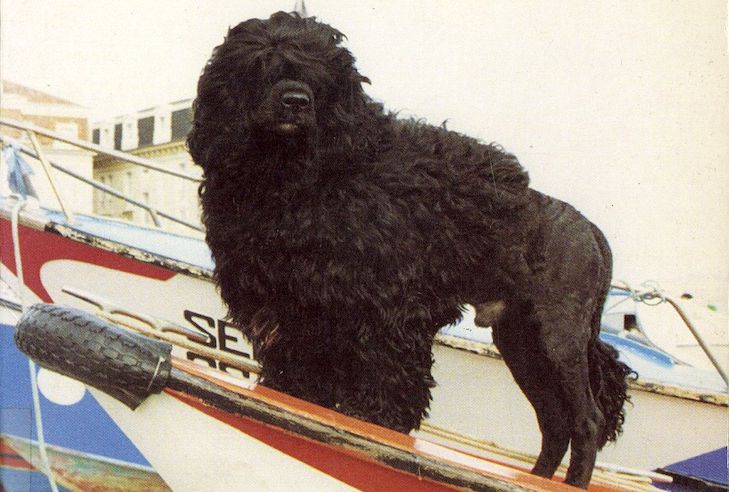
The traditional lion clip was used by Portuguese fishermen when their dogs were still working alongside them.
The dense, long coat on the front half of the body provided insulation and protected vital organs while the dogs worked in the cold waters of the Atlantic.
The clipped hindquarters allowed the dogs to move more efficiently through the water and made it easier for them to climb back into the boat.
The long tuft of hair left at the end of the tail also helped make the dog more visible among the waves.
ANCIENT ROOTS
The history of the Portuguese Water Dog reaches far back into the past.
The ancestors of today’s breed were probably brought to the Iberian Peninsula by ancient seafaring peoples who used capable water dogs during their voyages.
In the account, a monk describes a dog that rescued a drowning sailor.
The dog was described as having a coarse black coat, clipped approximately to the first rib, with a tuft of hair at the end of its tail – a description remarkably similar to the traditional lion clip of the Portuguese Water Dog.
A BREED ON THE BRINK OF EXTINCTION
With the introduction of modern fishing methods, the need for working dogs aboard fishing boats gradually disappeared.
The traditional way of life of Portuguese fishermen was changing, and with it the original working role of these exceptionally capable dogs was disappearing as well.
By the beginning of the 20th century, the number of Portuguese Water Dogs had declined significantly, and the breed gradually found itself on the brink of extinction.
1934 – A TURNING POINT IN THE BREED’S HISTORY
In 1934 two Portuguese Water Dogs in the traditional lion clip were presented to the public at an international dog show in Lisbon.
The dogs were brought by Frederico Pinto Soares, one of the prominent figures in the development of organised Portuguese cynology.
It was at this show that they caught the attention of Vasco Bensaúdea successful Portuguese businessman, breeder and devoted dog enthusiast.
Bensaúde recognised that the native Portuguese Water Dog was at risk of disappearing and decided to become actively involved in saving the breed.
ALGARBIORUM AND LEÃO
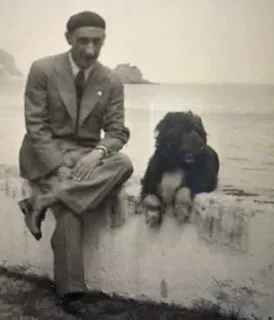
Vasco Bensaúde began searching along the Portuguese coast for typical working Portuguese Water Dogs and gathered dogs that became the foundation of his Algarbiorum kennel. Algarbiorum.
One particularly important dog was Leãooriginally a fisherman’s working dog.
His appearance and overall type became one of the principal models used in the development of the first official breed standard for the Portuguese Water Dog.
The first litter at the Algarbiorum kennel was born on 1st May 1937.
This marked the beginning of the modern era of systematic Portuguese Water Dog breeding.
FROM WORKING DOG TO THE MODERN PORTIE
Over the following decades, the Portuguese Water Dog gradually spread beyond Portugal.
Breeders sought to preserve the breed’s characteristic appearance, intelligence, willingness to work, endurance, love of water and exceptionally close bond with people.
A LEGACY THAT LIVES ON
Although Portuguese Water Dogs no longer work aboard fishing boats today, the breed has retained many of the qualities of its working ancestors.
Intelligence, endurance, courage, a close bond with people and an extraordinary passion for water remain characteristic qualities of the Portuguese Water Dog to this day.
Once an invaluable helper to fishermen, the Portuguese Water Dog has become a versatile family companion and sporting dog – yet its connection with water and people remains unchanged.