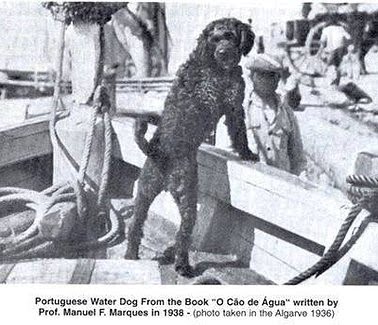
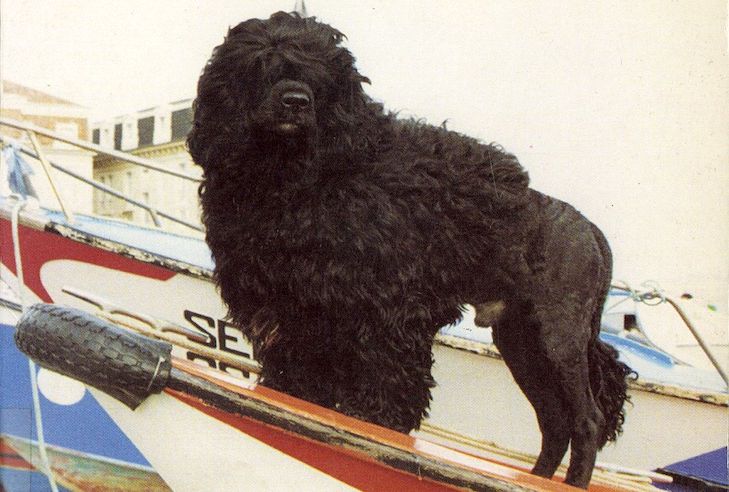
The Portuguese Water Dog originates from the Algarve region of Portugal and was used as a working dog by fishermen.
Porties have water-repellent fur and webbing between their toes to help them swim and dive.
The traditional "lion cut" was already used by fishermen to help dogs in their work. The thick, long fur on the front half of the body insulated the vital organs when the dog jumped into the cold Atlantic water. The clipped back helped the dogs move efficiently and made it easier to climb back into the boat. The long fur at the end of the tail served as a rudder and was well visible so that fishermen could follow the dog in the waves.
They were trained and used to chase fish into nets, retrieve damaged nets and equipment from the water, and as messengers between land and ship.
The history of this breed goes back to ancient times. The ancestors were probably brought to the Iberian Peninsula by ancient seafaring peoples.
The first written mention of a portie-like dog appeared in 1297, where a monk described a dog that saved a drowning sailor: "This dog had a black coat of thick hair, cut to the first rib and with a tuft at the end of the tail".
With the advent of modern fishing methods in the 19th century, the need for working dogs decreased and the breed faced the threat of extinction.
In 1934, at an international exhibition in Lisbon, the first two Portuguese water dogs with a lion cut were presented to the public, discovered on board a ship in a village by Frederico Pinto Soares, the founder of the Portuguese Cynological Club.
Both dogs aroused the interest of Dr. Vasco Bensuade, a wealthy Portuguese shipping magnate and dog lover, who decided to save this breed.
The first litter in his breeding station Algarbiorum was born on May 1, 1937 and started the modern history of the Portuguese water dog.